A “free day out” in London can become expensive surprisingly quickly.
There is the journey, food, parking, the inevitable drink somebody suddenly needs and the paid attraction sitting directly beside the free one your child has decided is the only thing worth doing.
For SEND families there is another cost as well: trying things that do not work.
You can spend £60 on tickets and discover within 15 minutes that the venue is too busy, the music is too loud or the activity is nothing like your child expected.
So for this guide we are being fairly strict. We are looking for London activities, sessions and attractions where the core experience is free and where we have found something genuinely useful for autistic or SEND visitors — not just a generic accessibility statement.
FREE MUSEUMS ARE ONE OF LONDON'S BEST SEND RESOURCES
London's free national museums are unusually valuable for autistic families because they remove the pressure to stay.
If you enter a free museum and your child manages 25 minutes, you can leave.
There is no feeling that you have thrown away a £90 family ticket. You can use the first visit as reconnaissance, learn which entrance works and come back another day.
That freedom can make a huge difference.
RAF MUSEUM LONDON
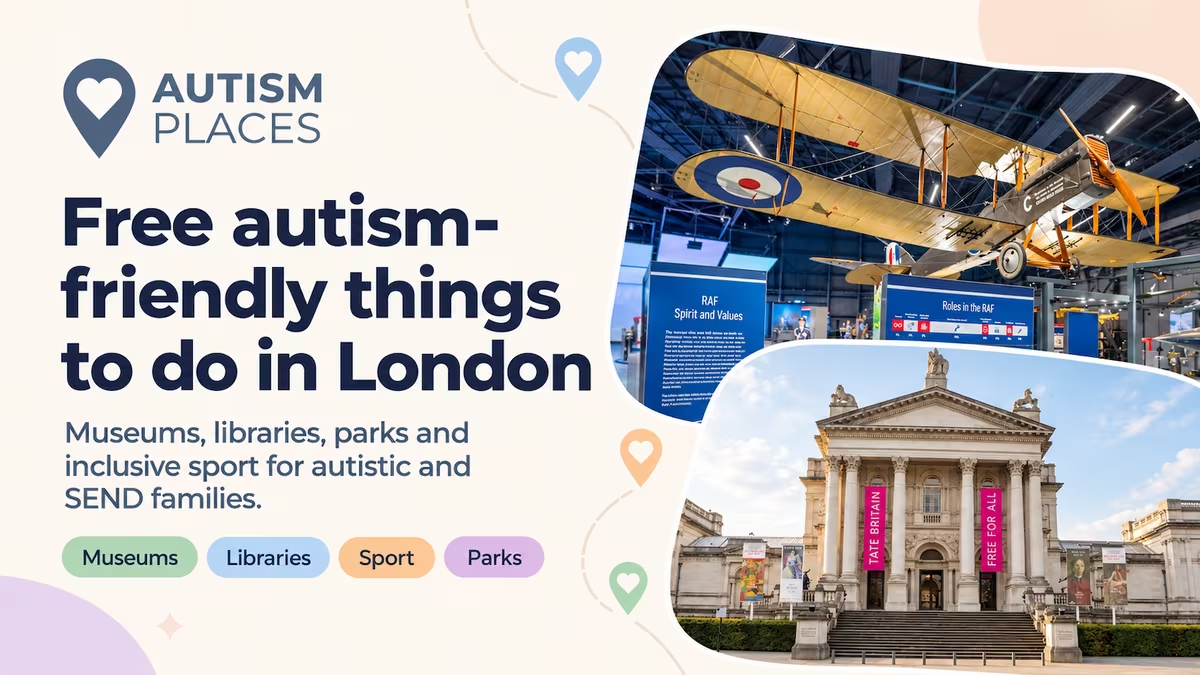
RAF Museum London is free to enter and has one of the more useful everyday neurodivergent access offers we have found.
It provides preparation materials such as a visual story, visual timetable and neurodivergent visitor information, along with quiet rooms and SEND Family Backpacks.
The museum itself is still a large aircraft environment with echoing hangars, school groups and interactive areas, but the point is that you can plan around those things.
For a child with a strong aircraft interest, free entry also means there is no pressure to see the whole museum. You can go to the favourite aircraft and leave.
SCIENCE MUSEUM
The Science Museum is free for general admission, although some experiences and exhibitions cost extra.
It has also developed sensory-friendly access programmes such as Early Birds for younger visitors and Night Owls for older young people and adults.
These sessions do not run every day, so the free general museum and the dedicated sensory programme should be thought of separately.
If you visit on an ordinary day, preparation and timing still matter because the museum can become extremely busy.
The paid extras are worth discussing before you enter if your child is likely to see them and want them.
“Free museum” is less convincing when the one thing they care about turns out to be a ticketed simulator.
IMPERIAL WAR MUSEUM LONDON
IWM London has free general admission and has offered Relaxed Hours to create a calmer visiting period.
The museum has subject matter and displays that can be emotionally intense as well as sensory, so we would look at what galleries you actually want to use before travelling.
For older children and teenagers in particular, a strong interest in history may make this a far better day than a more obviously child-focused attraction.
NATIONAL PORTRAIT GALLERY
The National Portrait Gallery is free to enter and currently offers both Relaxed Mornings and Quiet Mornings.
We particularly like the fact that it distinguishes between these.
A relaxed session may be useful for families who want freedom to move and vocalise without normal gallery expectations. A quiet session may suit somebody who wants fewer people and less noise.
Those are different access needs, and it is useful when a venue recognises that.
GUNNERSBURY PARK MUSEUM
Gunnersbury Park Museum is another free cultural option and has run dedicated relaxed sessions with sensory adjustments such as reduced sound, lower visitor numbers and access to quieter space.
Smaller museums can sometimes be easier than central London's huge attractions simply because the whole building is less intense.
Do not assume bigger museum means better SEND support in practice.
BRENT LIBRARIES' AUTISM-FRIENDLY MORNINGS
Libraries are easy to overlook because they do not feel like a “day out”.
But Brent Libraries' autism-friendly mornings are exactly the kind of low-stakes community experience that can be useful for children who need to practise using public spaces in a calmer environment.
Selected sessions have included earlier/quieter access, simple activity and visual preparation.
They are free, but they run on selected dates rather than being a permanent weekly offer at every library.
The benefit is that once a child becomes familiar with the library, the building can remain useful outside the dedicated session too.
FREE INCLUSIVE SPORT
Some of London's best no-cost SEND provision comes from charity or externally funded sport rather than commercial leisure venues.
Examples we have found include Track Academy and Access Sport's inclusive athletics and disability multi-sport programmes in North-West London.
These are particularly valuable because they are not just one-off sensory-friendly versions of an otherwise paid attraction. Some are regular activities a young person can build into their week.
The downside is that funding cycles change.
A session that is free this term may move venue, change eligibility or stop after a funded block.
Always check the current term before relying on an older listing.
GIRLS-ONLY DISABILITY SPORT
The girls-only multi-sports provision at Willesden Sports Centre is another example of funded activity that can be free to participants while offering a more specific environment for disabled girls and young women.
This kind of provision matters because SEND leisure can become male-dominated, especially in sport.
As always, check the real age mix, current timetable and whether the session can meet the participant's actual support needs.
PARKS AND OUTDOOR SPACES
London's parks are free, but calling a park “autism-friendly” without further information is not very useful.
The value of outdoor space depends on the person.
Some autistic children thrive with open space and movement. Others find unfenced areas unsafe because of bolting, become distressed by dogs or cannot tolerate crowded playgrounds.
For us, the practical questions are:
- Is the playground fenced?
- Are there quiet areas away from crowds?
- How close are roads or water?
- Are toilets available?
- Is there somewhere to retreat if the main playground is busy?
- Can you see the exit clearly?
A free park can be the best activity on the list, but only if its physical layout works for the person using it.
COMMUNITY EVENTS AND FAMILY HUBS
Councils, Family Hubs, libraries and charities regularly run free SEND or family activities that never become permanent attractions.
These can include sensory play, stay-and-play, holiday sessions, parent-and-child groups, crafts and community events.
They are also the hardest things to find because they may appear on one flyer or social post for two weeks and then disappear.
That is exactly the type of fragmented local information Autism Places is built to capture through live listings rather than pretending an article can hold every event forever.
HAF DURING SCHOOL HOLIDAYS
For eligible families, Holiday Activities and Food (HAF) programmes can provide free holiday activities and meals.
HAF is England-wide but administered locally, and the individual provider's SEND capability varies substantially.
A free HAF place can be brilliant, but the badge does not automatically mean specialist autism support.
Ask the provider about staffing, quiet space, communication, food and safety before assuming it will work.
Also factor in transport. Free provision can become expensive if getting there requires repeated taxis.
FREE RELAXED CULTURE DOES NOT ALWAYS MEAN FREE ENTRY
This is one distinction worth checking carefully.
Some relaxed sessions take place inside museums that are free anyway. Others are dedicated access performances at paid theatres or attractions.
So if the goal is genuinely zero-cost activity, confirm whether the session itself is included without an admission ticket.
We have deliberately kept paid relaxed theatre and commercial leisure out of the core free list even though some may offer excellent disability concessions.
CARER TICKETS AND CONCESSIONS CAN MAKE PAID THINGS MUCH CHEAPER
This guide focuses on free activities, but we would still look for:
- free essential-companion tickets
- disability concessions
- local-resident discounts
- leisure-card reductions
- hardship funds
- free trials
A £12 activity with a free carer place can sometimes be more realistic than a “free” session that costs £25 in transport.
The real family cost matters more than the label.
BOOKING FREE SESSIONS
Free does not mean turn up whenever you like.
Some of the best SEND sessions have limited capacity precisely because lower numbers are part of the adjustment.
That means booking can open weeks ahead and places can disappear quickly.
Before promising the activity to your child, check:
- whether advance booking is required
- whether a waiting list operates
- whether there is a refundable deposit
- whether everyone in the party needs a ticket
- whether a carer needs separate registration
- what happens if you cannot attend
PAID EXTRAS CAN CREATE A PROBLEM
A free attraction can still be full of paid extras: simulators, exhibitions, rides, shops and cafés.
If your child is likely to fixate on one of them, look at the venue map before travelling.
It may be easier to agree the plan at home than stand beside a ticket machine explaining why the “free day” does not include the thing they have just seen.
WE FOUND
The strongest genuinely free autism-friendly leisure in London currently comes from three places:
- Free cultural institutions that have invested in neurodivergent access.
- Charity-funded/community sport.
- Libraries, councils and community organisations running targeted sessions.
There is much less permanently free provision from commercial leisure operators.
And the local offer is uneven. Some boroughs have several regular SEND activities while families elsewhere have to travel.
WE'D ASK
- Is the core activity genuinely free?
- Do we still need to book?
- Is there a deposit?
- Are carers and siblings included?
- Are there paid extras likely to matter once we arrive?
- What actual autism/SEND adjustments are available?
- Does the session run regularly or only on selected dates?
- What ages actually attend?
- Can the provider meet higher support needs?
- What will transport and food make the day cost in reality?
OUR TAKE
Free activities are not a second-best option.
Some of London's strongest autism access is inside places that cost nothing to enter.
The ability to leave after half an hour, try again another day and build familiarity slowly can make a free museum or library more accessible than an expensive specialist attraction.
We will keep this guide connected to the live Autism Places listings because the funded and event-based options change constantly. The article should help you understand the landscape; the listings should tell you what is actually running.