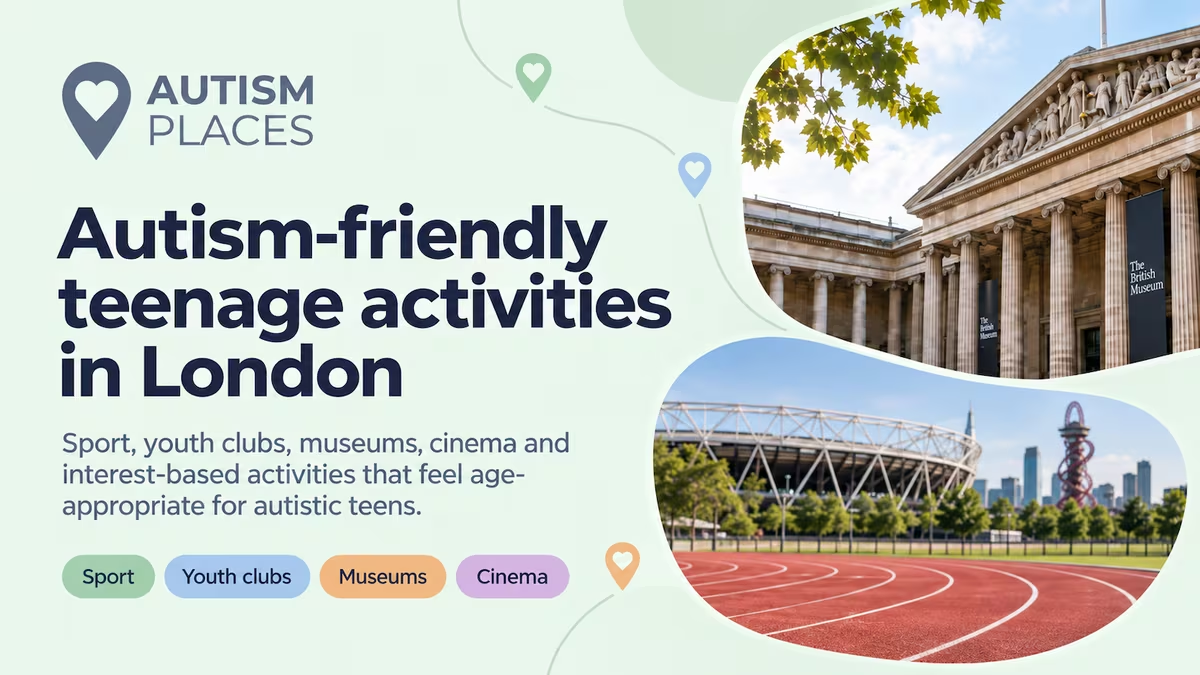
Teenagers fall into one of the most awkward gaps in SEND leisure provision.
A lot of "family" activities are really designed around primary-school children. The poster may technically say ages 5–16, but if almost everyone attending is seven, a 15-year-old can be included on paper and still feel completely out of place.
At the other end, adult autism groups often start at 18. That leaves a stretch of adolescence where young people are too old for children's provision, not yet eligible for adult groups and increasingly aware when an activity feels babyish.
So we looked for London activities where teenagers are genuinely part of the intended audience.
AGE RANGE IS NOT THE SAME AS AGE FIT
This is the first thing we would check.
A session can advertise ages 8–18 and still have an average age of ten.
For some autistic teenagers that does not matter. They may focus entirely on the activity. For others, it matters enormously.
Adolescence is already a time when young people can become more self-conscious about difference. Being placed into a group that feels visibly "for little kids" can be enough to stop them returning even if the staff are excellent.
So our favourite question is not "what age do you accept?"
It is "what ages actually come most weeks?"
INCLUSIVE ATHLETICS WITH TRACK ACADEMY
Track Academy, working with Access Sport, has run inclusive athletics sessions that include teenagers with SEND, including autism and ADHD.
Athletics can suit teenagers who want sport without the social complexity of a full team game. Running, jumping and throwing can be individual, progress can be measured against yourself, and a young person can enjoy movement without having to understand constantly changing team tactics.
But teenagers may still care about how the group feels socially.
We would ask whether other secondary-school-age young people attend, whether activities are adapted without becoming childish and whether participants can work on real athletics skills rather than only simplified games.
GIRLS-ONLY MULTI-SPORTS AT WILLESDEN SPORTS CENTRE
The girls-only disability multi-sports club at Willesden Sports Centre is particularly worth knowing because the age range extends into young adulthood.
Provision for disabled girls and young women can be much harder to find than mixed sessions.
Some autistic teenage girls also arrive at diagnosis later and may have spent years trying to fit into mainstream activities that never felt comfortable.
A girls-only environment with an adaptive coach can feel very different.
Multi-sports also lets a young person try different activities rather than committing to one sport immediately.
The thing we would check is how transitions are handled. A teen who loves badminton may not want to stop every ten minutes because the group is rotating to basketball.
Flexibility matters.
BLOOMSBURY FOOTBALL FOUNDATION
Bloomsbury Football Foundation has offered pan-disability football for young people extending into the teenage and young-adult years.
This can be a strong option for teenagers who genuinely love football but find ordinary club environments difficult.
Mainstream youth football often becomes more competitive as children get older. Instructions become faster, matches matter more and there can be greater social pressure from teammates and coaches.
A disability-focused session can provide a route to keep playing without all of that pressure.
We would still ask whether the session is recreational or competitive, whether players are grouped by age and ability, and what happens if somebody wants to practise skills but not play a match.
CAXTON YOUTH ORGANISATION
Caxton Youth Organisation is different because it is not simply a sports session.
It provides youth-club style opportunities for young people with learning disabilities and additional needs, with provision extending into young adulthood.
That matters because teenagers need places to hang out, not only structured therapeutic or sports activities.
A young person may want music, games, friends, trips and somewhere to be that is not school or home.
Youth-club provision can offer a level of ordinary teenage social life that SEND services sometimes forget.
If socialising is the goal, we would ask how structured the evening is and whether young people are expected to join group activities or can choose what they do.
SCIENCE MUSEUM NIGHT OWLS
The Science Museum's Night Owls programme is one of the clearer examples of a major London attraction recognising that sensory-friendly provision needs an older audience too.
Instead of every relaxed session being built around small children and family crafts, Night Owls is aimed at older young people and adults who benefit from a calmer museum experience.
For a teenager who loves science but hates daytime museum crowds, that can be much more age-appropriate than attending an early-years SEND morning.
We like this model because the adjustment is environmental without making the visitor feel infantilised.
MUSEUM QUIET AND RELAXED SESSIONS
Other London museums are also becoming better at separating family relaxed sessions from quiet sessions for older visitors.
The National Portrait Gallery, for example, runs both Relaxed Mornings and Quiet Mornings.
That distinction can matter for autistic teenagers.
Some teens want the freedom to move, talk, stim and use sensory tools without judgment. Others want the opposite: low noise, fewer people and no children's activities happening around them.
The phrase "autism-friendly" does not tell you which of those environments you are getting. Read the actual description.
CINEMA
Relaxed cinema screenings can still work well for teenagers, particularly if the film itself is age-appropriate.
The usual adjustments may include lower sound, some lighting left on and a more accepting attitude toward movement and noise.
But a 16-year-old who wants to see a mainstream new release may not be interested in a relaxed screening if the programme mostly shows children's films.
Check the film schedule rather than only searching for "autism cinema".
Some teenagers may do better in an ordinary off-peak screening with their own adjustments — aisle seat, ear defenders, familiar cinema, companion — than in a dedicated family relaxed screening.
There is no rule saying the specialist option must always be better.
INTEREST-BASED GROUPS
For many autistic teenagers, the most successful social group is one organised around an interest rather than around the instruction to "socialise".
Gaming, coding, art, anime, Lego, trains, music or tabletop games can provide a reason to be together without forcing constant conversation.
This is an area we want Autism Places to keep expanding because interest-based groups are often scattered across small charities and community organisations.
A young person who refuses a generic social-skills group may happily spend three hours discussing a game with peers.
That is social connection too.
SUPPORT LEVEL STILL MATTERS
Parents need to know whether a teen activity is actually staffed to meet their young person's needs.
Some teenagers are independent once they arrive. Others need closer support with communication, regulation, staying safely within the activity or understanding instructions.
"SEND-friendly" does not automatically mean one-to-one support.
Ask:
- Can the young person attend without a parent?
- What is the staff ratio?
- What happens if they need to step away from the group?
- Can staff support AAC or limited speech?
- What happens if they become overwhelmed?
For parents hoping a youth activity will also provide a meaningful break from caring, this distinction is crucial.
DO PARENTS HAVE TO STAY?
Teenagers often want more independence at exactly the point parents may still need to provide close supervision.
A good provider should be able to explain clearly whether parents:
- must stay in the room
- can stay elsewhere in the building
- can leave once the young person is settled
- are optional depending on support needs
There is no right answer for every family.
But knowing before you arrive avoids a teenager expecting independence and discovering their parent has to sit beside them for two hours.
TRANSPORT BECOMES PART OF TEENAGE INDEPENDENCE
An activity may be perfect and still inaccessible if the young person cannot travel there.
As teenagers get older, this becomes more important because families start thinking about travel training and future independence.
For some young people, attending a weekly club may be a good reason to learn one familiar route gradually.
For others, independent public transport may not be safe or realistic.
Do not let the language of "preparing for adulthood" turn travel into a moral test.
The goal is the greatest safe independence that works for that individual.
WHAT IF THE TEENAGER DOES NOT WANT A SEND GROUP?
Not every autistic teenager wants their leisure time organised around disability.
A teen may prefer an ordinary gym, drama group, coding club or football session with a few reasonable adjustments.
That is completely valid.
The best provision is not always the most specialist. Sometimes the better route is finding a mainstream activity built around a strong interest and making the environment accessible.
We would ask mainstream providers about:
- trial visits
- written schedules
- quiet spaces
- predictable staff
- reduced pressure to perform socially
- sensory adjustments
- whether a parent can support the first few sessions
TEENAGERS WITH HIGHER SUPPORT NEEDS
At the other end, there are teenagers whose needs cannot be met by a loosely supervised youth club.
They may need one-to-one support, high levels of safety supervision or staff experienced in complex communication and distress.
This is one of the clearest gaps we see.
Families may need social-care-funded Short Breaks or specialist youth provision rather than simply another "inclusive" activity.
If your teen needs that level of support, be explicit when enquiring. It is better to find out before travelling that the group cannot meet the need than to discover it in front of the young person.
COST
Teenage activities can become more expensive as the child moves out of cheaper children's provision.
Ask about:
- free trial sessions
- disability concessions
- free carer places
- hardship funds
- subsidised charity places
- whether payment is weekly or termly
Some of the best disability sport and youth programmes are externally funded and may be free or heavily subsidised.
But funded provision can change, so check each term.
WE FOUND
Teenagers need more than "older children's activities".
They need provision that respects their age, interests and growing independence while still providing the support they actually need.
The most promising London options tend to fall into a few groups:
- pan-disability sport
- youth clubs for disabled young people
- older-teen/adult relaxed museum sessions
- cinema and cultural access
- interest-based social groups
What is still missing is a much denser network of regular autism-informed teenage social activity that does not feel clinical or childish.
WE'D ASK BEFORE BOOKING
- What ages attend most weeks?
- Will my teenager be one of the oldest people there?
- Is it structured or can they choose activities?
- Do parents stay?
- Can staff support communication differences?
- Is there a quiet space?
- Can the teen visit first without committing?
- Is the group autism-specific, pan-disability or mainstream inclusive?
- What level of supervision is provided?
- Is the activity still appropriate for a 16- or 17-year-old socially, not just technically?
OUR TAKE
The teenage years should not become a waiting room between children's SEND services and adult provision.
Young people still need hobbies, friends, movement, culture, independence and places they actually want to go.
We will keep building this guide as we find more. If the only thing a session has going for it is that a teenager is technically under the upper age limit, that is not enough for us. We want to know whether it actually feels like somewhere a teenager belongs.