There is a big difference between a museum being technically accessible and a museum being somewhere an autistic person can realistically enjoy spending a few hours.
A lift and an accessible toilet matter. But they do not tell you whether the entrance queue is chaotic, whether hand dryers are painfully loud, whether the gallery suddenly goes dark, whether there is somewhere to recover from overload or whether you can show your child what the visit will look like before leaving home.
So when we started looking at autism-friendly museums in London, we ignored the vague "everyone is welcome" language and looked for actual adjustments.
This is not a ranking. One person's perfect museum is another person's sensory nightmare. What we wanted to find were places giving families enough information and flexibility to make that decision for themselves.
THE THING WE LIKE MOST: SPECIFIC INFORMATION
The strongest venues tell you what changes.
"Relaxed" on its own is not very useful. Does it mean fewer people? Lower sound? Brighter lighting? Hand dryers turned off? No school groups? A quiet room? Freedom to move around?
The more precise the venue is, the easier it is to work out whether it suits the person you are taking.
We have found two broad approaches across London.
Support you can use on an ordinary day
This includes visual stories, sensory maps, SEND backpacks, visual timetables, quiet rooms and guides to noisy or crowded areas.
The big advantage is flexibility. You are not forced into one Saturday morning every six weeks.
The disadvantage is that the museum itself may still be operating normally around you.
Dedicated relaxed or quiet sessions
These sessions usually change the environment for a fixed period: reduced numbers, lower sound, fewer tours, calmer lighting or extra access support.
For some families, that is the difference between being able to visit and not attempting it at all.
The trade-off is that the dates are limited, and the exact meaning of "relaxed" varies between venues.
RAF MUSEUM LONDON
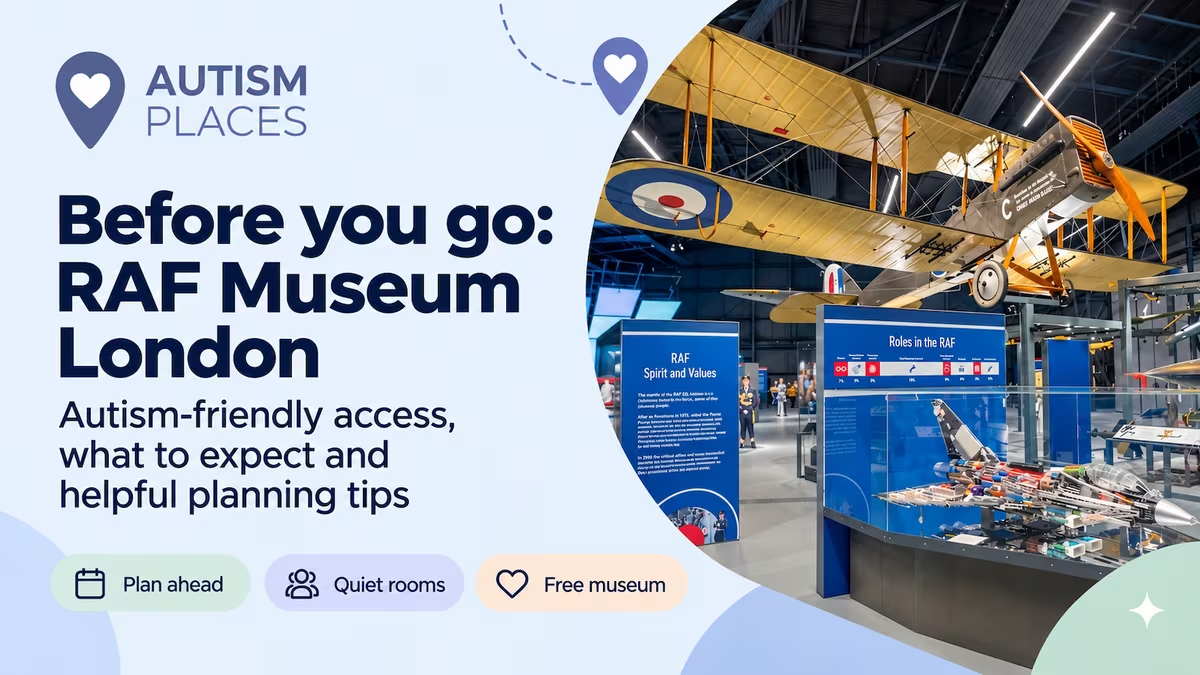
RAF Museum London is one of the strongest examples we found for support that exists beyond a special-event date.
The museum's current accessibility information includes a neurodivergent visitor guide, visual story, visual timetable, quiet rooms and SEND Family Backpacks available to borrow. The museum has also received the National Autistic Society's Autism Friendly Award.
We like this because preparation is useful even if you never attend a dedicated SEND event.
An aircraft museum can still be a huge sensory environment. There are large hangars, echoes, engines, interactive areas, school groups and busy holiday periods. But knowing where the quiet spaces are and being able to preview the visit changes the level of uncertainty.
For children with a strong interest in aircraft, that preparation may be all they need to turn an overwhelming day into a brilliant one.
SCIENCE MUSEUM
The Science Museum has long been one of London's more developed venues for dedicated neurodivergent access sessions.
Its Early Birds programme is aimed at younger visitors, while Night Owls has created a quieter museum experience for older young people and adults. It has also run specialist SEND experiences such as SENsory Astronights.
The age spread is important.
A recurring problem with autism-friendly family provision is that it disappears just as children become teenagers. A 16-year-old may still need lower visitor numbers, predictable lighting and space to regulate, but does not want to be treated like a six-year-old.
The Science Museum is one of the places showing that sensory access does not have to stop at childhood.
TOWER BRIDGE
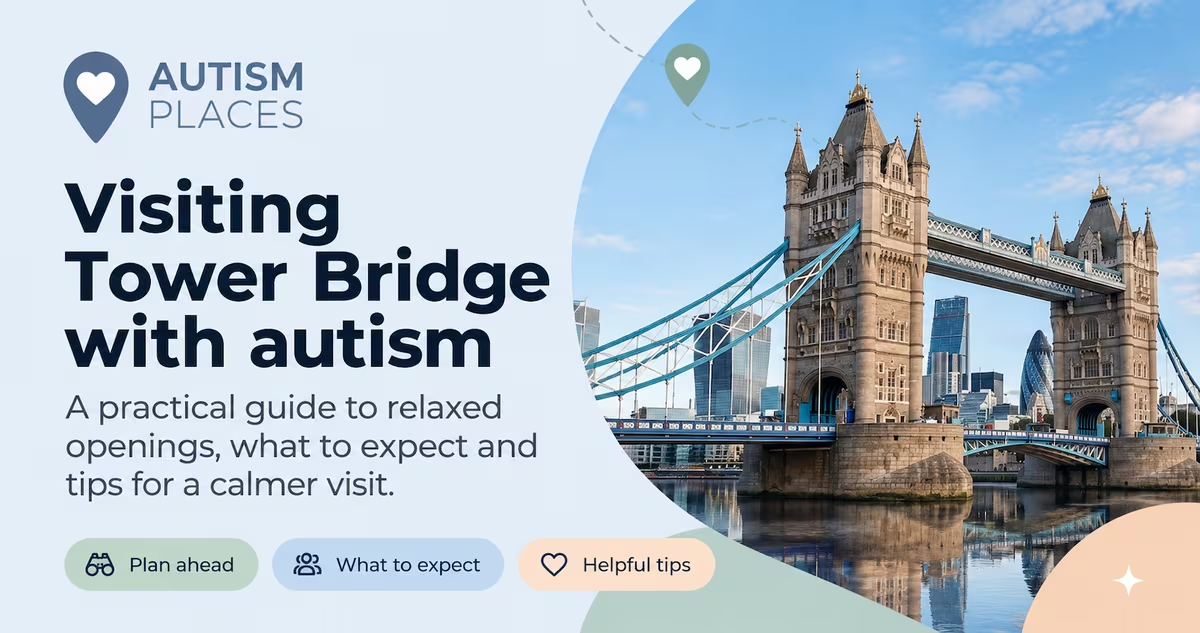
Tower Bridge runs a dedicated Relaxed Opening on the second Saturday of each month.
The current format is unusually specific: reduced visitor numbers, no guided tours or group bookings during the session, hand dryers switched off, disposable towels provided, reduced sound on videos and soundscapes, and access toolkits with sensory items.
There is also a visual story available before visiting.
This is exactly the sort of detail we want.
It tells a family that "relaxed" affects crowding, noise and some predictable sensory triggers rather than simply being a marketing label.
Tower Bridge also distinguishes its neurodivergent-focused Relaxed Opening from its wider "Quieter Time", which is useful because not every person seeking a calm visit needs the same thing.
NATIONAL PORTRAIT GALLERY
The National Portrait Gallery runs both Relaxed Mornings and Quiet Mornings.
That distinction is interesting.
Relaxed Mornings are designed for children with SEND, families and people with sensory differences and allow a more informal way of using the Gallery. Visitor numbers are reduced and sensory elements are minimised. The Gallery also provides visual preparation in advance.
Quiet Mornings are aimed more broadly at neurodivergent people and anyone who benefits from a calm, low-noise environment, including adults who may not want a family-style relaxed event.
Again, that shows a more mature understanding of access. Some autistic people need freedom to move and vocalise. Others desperately want a silent gallery with fewer people. Those are not the same access need.
IMPERIAL WAR MUSEUM LONDON
IWM London has offered Relaxed Hours with changes to create a calmer visit, including adjustments to sound and lighting and reduced pressure from normal visitor flow.
Museums dealing with war can contain sudden noise, dark displays and emotionally intense material, so sensory preparation is not the only consideration here.
If you are visiting with a child or vulnerable adult, we would look at both the sensory information and the subject matter before choosing galleries.
ROYAL MUSEUMS GREENWICH
The museums at Greenwich, including the National Maritime Museum and Cutty Sark, have run dedicated relaxed programmes.
Current Cutty Sark relaxed openings are designed for neurodivergent visitors, people with sensory sensitivities and anyone who benefits from a quieter way to explore the ship.
The physical environment is worth thinking about separately from the event label. A historic ship involves narrow spaces, stairs, unusual surfaces and a very different layout from a conventional gallery.
A reduced-capacity session may solve crowding but not necessarily make the structure of the building comfortable for every visitor.
That is why we would still look at access information and photos before travelling.
THE POSTAL MUSEUM
The Postal Museum has developed relaxed events with input from autistic young people through Ambitious about Autism.
That co-production matters.
The museum includes Mail Rail, an underground train ride, as well as galleries and children's play areas, so there are several very different sensory environments inside one attraction.
For a child who loves trains, Mail Rail could be the highlight of the year. For somebody who dislikes enclosed spaces or unexpected sound, it may be the part you deliberately skip.
A good access offer lets both choices be valid.
GUNNERSBURY PARK MUSEUM AND OTHER LOCAL MUSEUMS
Smaller museums can sometimes offer a calmer experience than London's major attractions even without a huge access programme.
Gunnersbury Park Museum has run Relaxed Sessions with reduced sound, limited numbers, a quiet room and adapted activities.
We would not dismiss smaller local museums simply because they have fewer branded SEND events. The ordinary visitor numbers may already be much lower, and staff can sometimes be more flexible about adapting a visit.
FREE ENTRY CHANGES THE CALCULATION
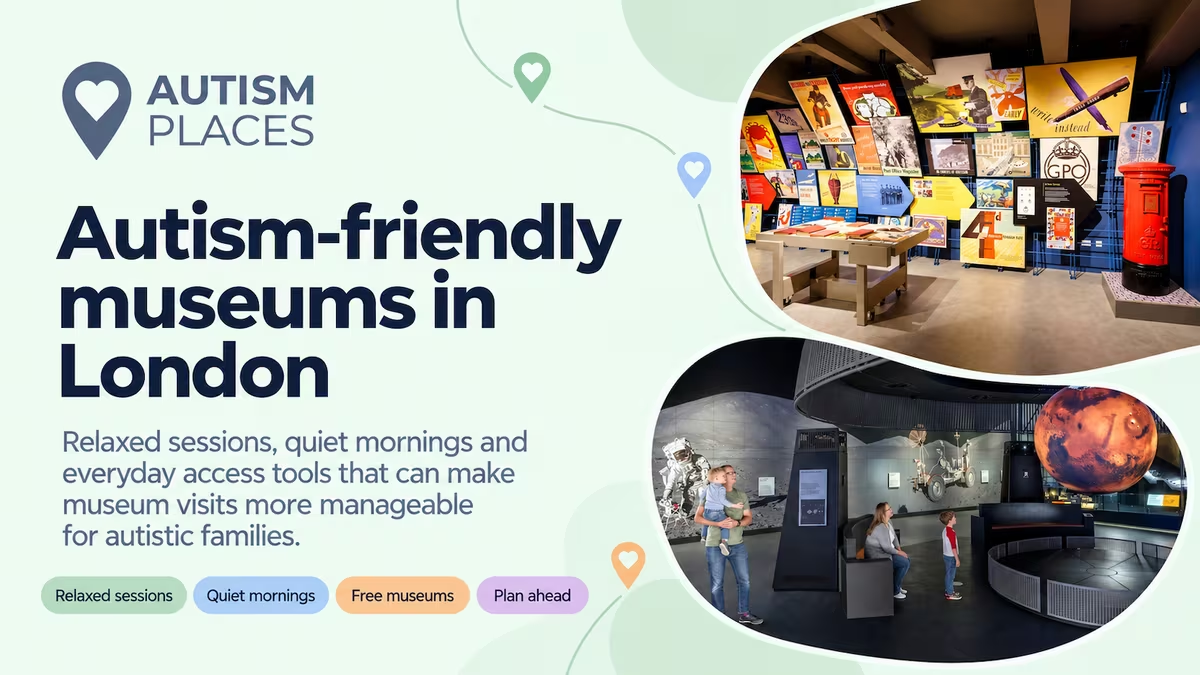
A lot of London's national museums are free to enter.
For SEND families, that is more than a money-saving detail.
It removes the pressure to "get your money's worth".
If you arrive and the museum is completely wrong that day, leaving after 25 minutes does not feel like abandoning a £90 family ticket. You can treat the first visit as reconnaissance and come back another time.
That can make free museums particularly good places to build confidence with days out.
WHAT A RELAXED SESSION DOES NOT GUARANTEE
A relaxed session is not necessarily silent.
Other neurodivergent families will be there. Children may vocalise, run, flap, move between spaces or need support during distress. That is part of the point: people should be able to use the venue without constantly being asked to look "museum appropriate".
If the person you are with needs quiet rather than relaxed rules, look for a dedicated quiet session or a low-visitor ordinary period instead.
Likewise, reduced numbers do not remove every sensory feature. Large galleries still echo. Glass walkways still look high. Interactive displays still exist unless the venue specifically says they are switched off.
HOW WE'D CHOOSE A MUSEUM
We would start with the person's biggest barrier rather than the museum's label.
If crowds are the problem
Look for reduced-capacity or early-opening sessions.
If unpredictability is the problem
Prioritise visual stories, photos, maps and information about the route through the building.
If noise is the problem
Check exactly which sounds are reduced. Ask about hand dryers, tannoys, interactive exhibits and school groups.
If regulation space matters
Look for an actual quiet room or a clearly identified low-stimulation space.
If fixed schedules are difficult
A museum with everyday access tools may be better than a brilliant relaxed session that only happens once a month.
If the person is an autistic adult
Check the audience carefully. Some sessions are genuinely all-age; others are technically open but designed very obviously around small children.
WE'D ASK BEFORE TRAVELLING
- Is this adjustment available every day or only at a special event?
- Are visitor numbers actually capped or merely expected to be lower?
- Are school groups or guided tours excluded during the session?
- Is there a genuinely separate quiet room?
- Can we download a visual story before travelling?
- Is there a sensory map showing loud, dark or crowded areas?
- Are hand dryers, tannoys or interactive sounds switched off?
- Can a carer or essential companion attend free where the venue charges admission?
- Is there a Changing Places toilet if needed?
- Can we leave a gallery and come back later?
- If we arrive late for a relaxed session, will we still be admitted?
WE FOUND
The best autism access is becoming less about putting on one "special needs morning" and more about giving visitors control.
Control over when to visit. Control over preparation. Control over whether to use a quiet room. Control over whether to stay with the group. Control over leaving early.
That is a much better measure of accessibility than whether a venue has put an autism logo on its website.
BEFORE YOU GO
Dedicated sessions change dates, formats and booking rules, so always check the current event page before travelling.
Autism Places keeps the individual venue and event information in the related listings; this Guide is here to help you understand the differences between the offers and work out what is likely to matter for your family.
The goal is not to find a museum that promises to be "autism-friendly". It is to find one that gives you enough honest information to decide whether this visit, on this day, for this person has a good chance of working.