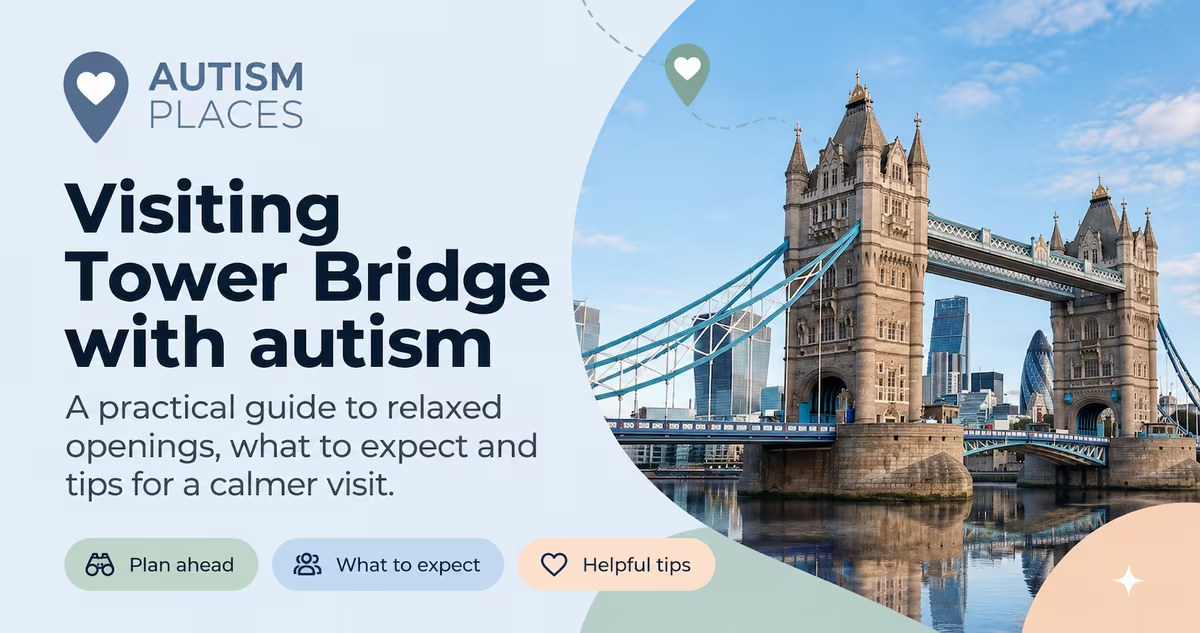
Tower Bridge is a brilliant London attraction, but it is also a very particular sensory environment.
There are lifts, high-level walkways, glass floors, machinery, narrow transitions between spaces and a constant flow of tourists moving through a fairly defined route.
For someone who likes engineering, bridges or big London landmarks, that can be fascinating. For somebody who struggles with crowds, hand dryers, unpredictable sound or being moved along with a group, it can become a lot very quickly.
Tower Bridge's Relaxed Opening is the version we would look at first for a neurodivergent visitor who wants the full attraction with some of those pressures reduced.
And, importantly, Tower Bridge is unusually clear about what actually changes.
WHEN THE RELAXED OPENING HAPPENS
Tower Bridge currently runs Relaxed Opening on the second Saturday of each month, from 09:30 to 11:30.
The exact dates are published through the live booking page, so check the current calendar before building the day around it.
The relaxed period is included in the normal entry ticket rather than being a completely separate attraction.
WHAT ACTUALLY CHANGES
Tower Bridge says Relaxed Opening includes:
- further reduced visitor numbers
- no guided tours or group bookings during the relaxed period
- hand dryers switched off, with disposable towels provided
- reduced volume on soundscapes and video
- freedom for neurodivergent visitors to move and engage with the attraction in the way that suits them
- access to sensory toolkits
- a visual story for preparation
These are useful adjustments because they target several predictable pressure points at once: crowding, sudden toilet noise, audio and social expectations.
This is much more informative than simply calling the session “autism-friendly”.
RELAXED OPENING IS NOT THE SAME AS QUIETER TIME
Tower Bridge also offers Quieter Time.
The venue itself explains the difference: Quieter Time is for anyone wanting a calmer experience, while Relaxed Opening is specifically designed around neurodivergent visitors and a more flexible way of using the attraction.
That distinction matters.
Some autistic people want fewer visitors but otherwise prefer ordinary museum etiquette. Others need to know that moving, vocalising, using sensory tools or taking the visit at their own pace will be accepted.
Choose the format that matches the person rather than assuming the autism-specific option is automatically better.
YOU CAN STAY AFTER 11:30
One of the most useful practical details is that the end of Relaxed Opening does not mean everybody is pushed out at 11:30.
Tower Bridge says visitors can stay as long as they like after the attraction opens more fully to the general public.
That gives families control.
You can use the quieter window to do the areas likely to be hardest, then decide whether to continue once normal visitor numbers increase.
If things are going well, stay.
If the difference in crowd level becomes obvious, leave while the day is still successful.
THE GLASS FLOOR
For some children, the glass walkway will be the reason for going.
For others, it may be the absolute worst part of the entire attraction.
You do not have to stand on it.
Prepare for the fact that it exists before arriving, particularly if the person has difficulty with heights, visual depth or unexpected floor surfaces.
Show photos in advance if that helps.
And do not turn it into a bravery test.
An autistic child enjoying the Bridge while deliberately avoiding the glass is still enjoying Tower Bridge.
LIFTS, STAIRS AND MOVING THROUGH THE ROUTE
Tower Bridge is not one open museum hall. The visit involves moving through different sections, including the Towers, high-level walkways and Engine Rooms.
If lifts are difficult because of enclosed space or waiting with strangers, ask staff what alternatives are available and which parts of the route involve stairs.
If stairs are difficult, ask the accessibility team about the step-free route.
The best time to understand that is before the visitor is already dysregulated in a lift queue.
SOUND HAS BEEN REDUCED, NOT REMOVED
The relaxed session reduces volume on soundscapes and video, but the Bridge is still a working London attraction.
There can be people talking, mechanical/environmental noise and city sound around the site.
If ear defenders are normally useful, bring them.
The venue's sensory toolkit is helpful, but we would not depend on it for an item the person absolutely needs.
Bring familiar regulation tools from home.
THE HAND-DRYER DETAIL IS BETTER THAN IT LOOKS
Switching off hand dryers might seem like a tiny adjustment compared with reduced visitor numbers.
For a lot of autistic children, it is not tiny at all.
Toilets can be one of the most unpredictable parts of a day out because somebody else can trigger a very loud dryer without warning.
Tower Bridge explicitly replacing them with disposable towels during Relaxed Opening shows the kind of detail we like to see from an attraction.
It is an adjustment families can actually understand before travelling.
SENSORY TOOLKITS
Tower Bridge says access toolkits contain sensory items intended to help with distraction, play and sensory management when somebody becomes overwhelmed.
Visitors can ask staff for items from the kits.
We would still bring whatever the person already uses successfully — headphones, fidget, chewy, comfort item or AAC.
A venue toolkit works best as extra support, not as a replacement for familiar equipment.
VISUAL STORY
The visual story is worth using before the day if uncertainty is a barrier.
Rather than only telling a child “we're going to Tower Bridge”, you can show what the entrance, route and spaces look like.
Some children benefit from seeing the whole sequence. Others only need the next two steps.
Adapt the preparation to the person.
The goal is not getting them to memorise the attraction. It is reducing the number of surprises.
THE ENGINE ROOMS FEEL DIFFERENT FROM THE WALKWAYS
The attraction changes character as you move through it.
The high-level walkways are about views, height and open visual space. The Engine Rooms contain historic machinery and a different kind of sensory environment.
If the person's interest is specifically mechanical, that may be their favourite part.
If they are already tired by the time you get there, it may be the point where the visit becomes too much.
You do not have to complete every section.
A selective visit is completely valid.
TIMED ENTRY CAN HELP — IF YOU CHOOSE THE RIGHT TIME
Relaxed Opening uses booked entry rather than an uncontrolled arrival rush.
That can make the start more predictable.
But do not automatically select the earliest possible slot if your child finds mornings difficult.
The best access adjustment is sometimes the one you make yourself: choose the entry time that fits sleep, medication, food, school-holiday routine or travel.
There is no prize for arriving at 09:30 if the household is already in crisis by 09:15.
GETTING THERE MAY BE MORE SENSORY THAN THE BRIDGE
Tower Bridge is in central London.
The journey can involve crowded trains, stations, tourists, road noise and a busy riverside before you even enter the attraction.
Plan the travel as part of the day.
If possible, know which station exit you want, where you can pause before entry and whether the person needs recovery time after the journey.
A beautifully relaxed museum session cannot undo a completely overwhelming trip across London.
FOOD AND BREAKS
Do not wait until the person is visibly overloaded to take the first break.
Tower Bridge is a fairly linear attraction, so think about where you can pause and what food/drink arrangements work for your family.
If eating is restricted, bring a reliable plan rather than assuming the nearest café will have something suitable.
And remember that hunger, tiredness and ending a preferred activity can all look like “sensory meltdown” when several pressures arrive at once.
IF YOU NEED TO CHANGE THE DATE
Tower Bridge's current ticket terms allow standard-entry, Relaxed Opening and Quieter Time bookings to be moved to another date/time in advance, subject to its conditions and any price difference.
That flexibility is useful for SEND families because sometimes the reason a visit cannot happen is not predictable until that morning.
Check the current ticket terms rather than assuming a refund is available; transfers and refunds are not the same thing.
WHO THIS LOOKS BEST FOR
We think Relaxed Opening is particularly promising for visitors who:
- are interested in Tower Bridge but struggle with normal tourist crowds
- are sensitive to hand dryers or loud media
- benefit from visual preparation
- need more freedom to move or engage differently
- want the possibility of staying longer if the visit goes well
We would still plan carefully for somebody with a strong fear of heights, lifts or narrow transitions because those parts of the building remain physically real even when the session is relaxed.
WE'D ASK BEFORE BOOKING
- Where are the calmest places if somebody needs a break?
- What is inside the sensory toolkit?
- Which parts of the route involve lifts or stairs?
- Can the glass floor be avoided completely?
- Is there a Changing Places toilet if required?
- How does re-entry work if somebody needs to step outside?
- What happens if we arrive late for our timed slot?
- How much busier does it usually become after 11:30?
- What companion/access ticket arrangements apply to our booking?
OUR TAKE
Tower Bridge's Relaxed Opening is one of the better examples of a venue explaining access in concrete terms.
We know what changes: visitor numbers, tours, dryers, sound and audience expectations.
That gives families something real to plan with.
The Bridge itself is still the Bridge — high, mechanical, visually dramatic and routed through several different spaces. But if the main barriers are crowds, noise and pressure to behave like a conventional tourist, the Relaxed Opening removes a meaningful amount of that friction.