Inflatable parks are exactly the kind of place where the words "SEN-friendly" can sound reassuring without telling you very much.
For one autistic child, a giant inflatable arena is sensory heaven: bouncing, crashing, climbing, deep pressure and constant movement. For another, the combination of music, children shouting, unpredictable bodies and a huge open space is overwhelming before they have even taken their shoes off.
So the useful question is not whether Inflata Nation Colindale calls the session SEN-friendly.
It is what actually changes, and what stays exactly the same?
WHAT CHANGES AT THE SEN-FRIENDLY SESSION
Inflata Nation has advertised SEN-friendly sessions with reduced capacity and music turned down compared with a standard session.
Those two changes can matter a lot.
Lower capacity means fewer bodies moving unpredictably around the arena and less pressure at popular obstacles. Quieter music removes one constant layer of sound from an already noisy environment.
A parent or carer can also usually join the arena under the venue's carer arrangements, subject to the current booking conditions and evidence requirements.
That can make the session much more practical for a child who cannot safely use the arena independently.
WHAT DOES NOT CHANGE
This is the important bit.
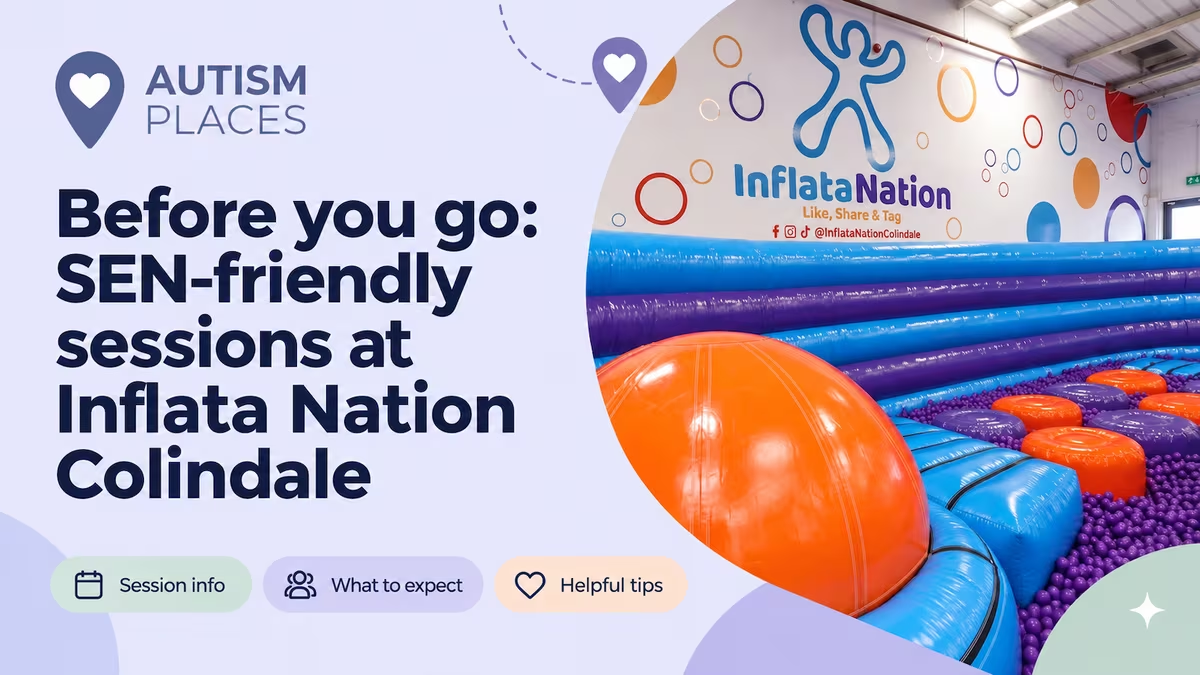
It is still an inflatable park.
There will still be:
- bouncing
- people falling and landing
- children shouting
- air pumps and equipment noise
- bright colours
- movement in every direction
- safety instructions
- transitions on and off equipment
- other families using the space
Reduced capacity does not turn the arena into a quiet sensory room.
That does not make the SEN session bad. It just tells you who it may suit.
A child who actively seeks movement but struggles with packed venues and loud background music may absolutely love it.
A child who needs a very low-arousal environment may still find it far too intense.
BEFORE YOU BOOK: THINK ABOUT THE SENSORY PROFILE
We would ask ourselves what normally causes the problem on active days out.
If it is mainly crowds, the reduced capacity may help enormously.
If it is music, turning it down may be enough to make the difference.
If it is unpredictable physical proximity, an inflatable arena may still be difficult even with fewer people.
If the child is movement-seeking, the actual equipment could be regulating rather than overwhelming.
The phrase "sensory needs" covers people who seek stimulation and people who avoid it. A good SEND session needs to make sense for both, and sometimes that means recognising that the same venue simply will not work for everyone.
ARRIVE EARLY, BUT NOT SO EARLY THAT YOU CREATE A LONG WAIT
Inflata Nation sessions usually involve check-in, socks, shoes, waivers or safety information before the child gets into the arena.
Those transitions can be harder than the activity itself.
We would aim to arrive with enough time not to rush, but avoid creating 30 minutes of standing around if waiting is difficult.
Complete anything online before travelling where the booking system allows it.
Have socks and clothes ready.
Explain the sequence in very simple terms:
check in → shoes off → safety → bounce → shoes on → home.
For some children, knowing exactly when the preferred activity starts makes the boring parts much easier to tolerate.
CLOTHING CAN MATTER
Active inflatable venues involve heat, friction and lots of movement.
If your child is sensitive to clothing, choose something familiar rather than treating the trip as the day to try a new outfit.
Check the venue's current rules on grip socks and clothing before travelling.
If special socks have to be bought, include that in the real cost of the visit rather than only looking at the headline ticket price.
CARER ACCESS: CHECK THE CURRENT RULE
The carer place is useful, but we would still check exactly how it works at Colindale before booking.
Questions worth asking:
- Is the carer ticket free?
- Does the carer need to be on the arena or can they stay at the edge?
- What evidence is accepted?
- Do carers need grip socks too?
- Can more than one adult attend if the child needs two-person support?
- Is the carer place booked online or added at reception?
The answer may change between venues in the same chain, so we would not assume another Inflata Nation branch has identical rules.
IF YOUR CHILD NEEDS TO LEAVE THE ARENA
One of our biggest practical questions would be re-entry.
Some autistic children regulate brilliantly for 20 minutes, suddenly need five minutes away, then are ready to go back.
If leaving the arena ends the session, that changes how usable the visit is.
Ask before you go:
- Can the child step out and return during the booked hour?
- Is there somewhere quieter to sit?
- Can a parent remain with them without losing the arena place?
- What happens if they need to stop after ten minutes?
The ability to pause can be more valuable than an extra sensory toy.
QUIET SPACE
We would not assume the venue has a dedicated quiet room unless Colindale confirms it.
A café or seating area may be quieter than the arena but still busy.
If your child needs a genuinely low-stimulation place to recover, ask exactly what is available.
"There is somewhere to sit" and "there is a quiet room" are not the same thing.
If there is no dedicated space, think about whether the car could realistically be your reset point and whether re-entry would still be possible afterwards.
SAFETY AND BOLTING
Large active venues need a bit more planning for children who run unexpectedly or have low danger awareness.
Reduced capacity helps with visibility, but it does not remove risk.
We would want to know:
- how access to and from the arena is controlled
- whether children can leave the main activity space without passing staff
- whether a supervising adult can stay beside the child throughout
- what staff do if a child becomes distressed or tries to exit
Tell staff anything they genuinely need to know. You do not have to deliver your child's entire history at reception, but a clear statement such as "he may run when overwhelmed and needs me beside him at all times" is useful.
FOOD AND DRINK
Physical activity can change regulation quickly. Some children come off an inflatable park very thirsty, hungry and tired.
If food is restricted, do not assume the venue café will solve it.
Check current rules on bringing snacks and drinks, and have the child's reliable option ready for afterwards.
Sometimes the transition out of a favourite activity is harder than the transition in. A predictable drink/snack or next step can help.
THE END OF THE SESSION MAY BE THE HARDEST PART
A timed session means somebody eventually says it is finished.
For a child who loves bouncing, that can be brutal.
If endings are difficult, prepare for that before the session starts.
A visual timer, countdown or very clear "five more minutes, then shoes" routine may help.
If your child does not understand conventional time, use something concrete: "three more slides" or "two more jumps on this one, then shoes."
The exact method depends on the child, but we would never spring the ending on them if we already know endings cause distress.
BUSY AREAS OUTSIDE THE ARENA
Remember that a lower-capacity session controls the booked activity more than the whole journey.
Reception, corridors, changing areas, toilets and the surrounding retail/transport environment may still be busy.
If the child copes with the arena and then becomes overwhelmed at check-out, that does not mean the SEN session failed. It means access planning needs to include the parts venues often forget.
WHO WE THINK THIS SESSION MAY SUIT BEST
Based on the adjustments, this looks most promising for children and young people who:
- enjoy active movement and bouncing
- can cope with an energetic environment when crowd numbers are lower
- find loud music difficult
- benefit from having a parent/carer alongside them
- struggle more with standard busy sessions than with the equipment itself
We would be more cautious where somebody needs near-silence, very predictable personal space or a genuinely calm environment throughout.
WE'D ASK BEFORE BOOKING
- What is the current SEN-friendly session time?
- How much lower is capacity than a standard session?
- Is music only reduced or switched off?
- Is there a quiet room or genuinely quiet break area?
- Can a child leave and re-enter during the session?
- What evidence is needed for a carer ticket?
- Are grip socks included?
- Can parents/carers remain on the arena throughout?
- Are any attractions unavailable during SEN sessions?
- What happens if the child cannot complete the whole session?
OUR TAKE
The SEN-friendly session appears to make meaningful but limited changes.
Reduced capacity and quieter music are not token adjustments. For the right child they could transform the visit.
But we would not describe it as a low-sensory environment, because the core attraction is deliberately high-energy.
That honesty is important.
If your child loves movement and the thing stopping you from trying Inflata Nation is the normal crowd and music level, the SEN session looks worth considering. If they need genuine calm, we would choose a different kind of activity rather than expecting the label to change what an inflatable park fundamentally is.
Check the live Colindale booking page before travelling because session times, prices and booking conditions can change.