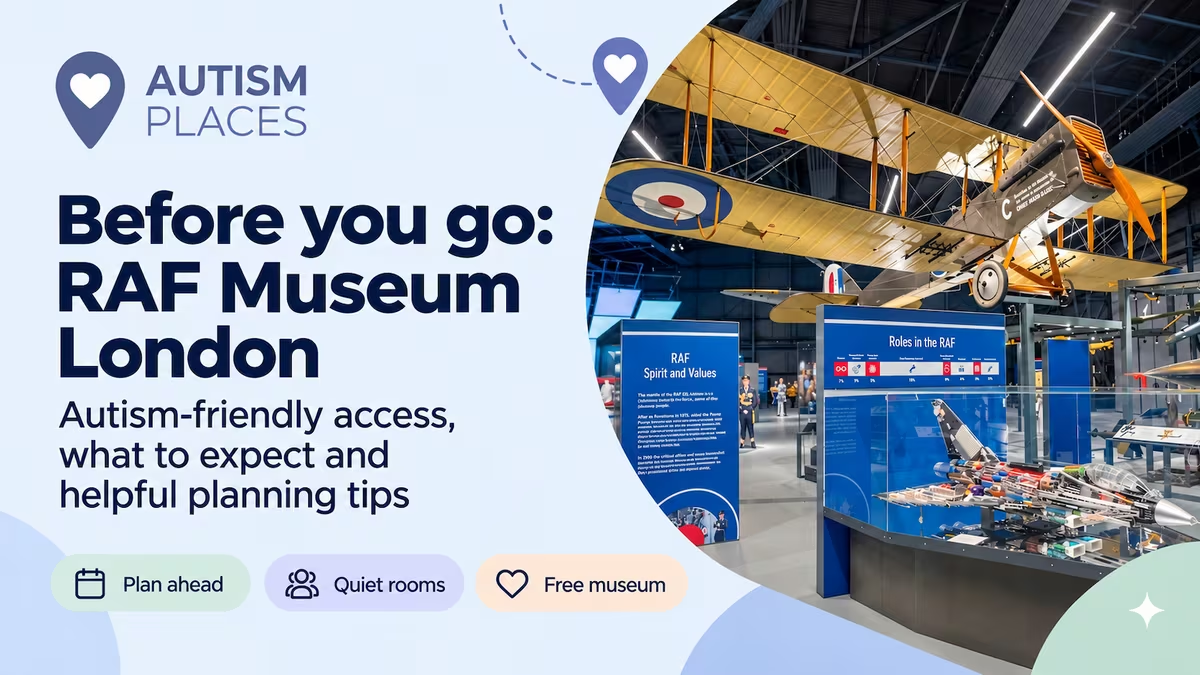
RAF Museum London is one of those places that can be either an incredible day out or far too much, depending on the person, the time of day and how prepared you are.
There are huge aircraft at eye level, enormous hangars, engines, interactive areas and a lot to look at. For an autistic child with a strong interest in planes, that can be perfect. For a child who is overwhelmed by echoes, crowds or sudden noise, the same environment can become difficult very quickly.
The good news is that RAF Museum London has done more than put a generic accessibility statement on its website. There are practical neurodivergent resources you can use before and during the visit.
This is what we would want to know before going.
THE BIGGEST POSITIVE: YOU CAN PREPARE PROPERLY
The museum currently provides a neurodivergent visitor guide, a visual story and a visual timetable.
That combination is useful because different children need different types of preparation.
A visual story can help somebody understand what the building, entrance and visit may look like. A timetable can make the order of the day more predictable. The visitor guide can help the adult spot potential pressure points before arriving.
If your child copes much better when they know what is going to happen, we would use these before the visit rather than introducing them for the first time at the museum door.
You could even make the day simpler than the museum's own timetable: "car, museum, planes, snack, more planes, home" may be enough.
SEND FAMILY BACKPACKS
The museum says SEND Family Backpacks are available to borrow from the main entrance.
These can provide sensory and communication support during the visit and are one of the strongest practical parts of the offer.
We would still treat a backpack as a bonus rather than the whole plan. The museum does not publish a live count showing how many are left at any moment, and equipment can be first-come, first-served.
If your child depends on a particular item such as ear defenders, chewy jewellery, AAC or a familiar fidget, bring your own rather than relying on the venue having one.
QUIET ROOMS
RAF Museum London says there are quiet rooms throughout the museum.
This matters much more than a vague promise that staff can "find somewhere quiet" if needed.
When a child is already overloaded, walking around asking for a spare office is not much of an access plan.
Before you start exploring, we would ask a member of staff where the nearest quiet room is and, if possible, point it out to the child. That makes the escape route familiar before it is needed.
Do not wait until meltdown to discover how far away the calm space is.
THE MUSEUM IS FREE — AND THAT HELPS MORE THAN IT SOUNDS
General admission to RAF Museum London is free, although parking, special activities or events may have separate costs.
For SEND families, free entry changes the psychology of the day.
You do not need to stay four hours to justify the ticket price.
You can go in, see two aircraft, have a snack and leave if that is enough. You can even treat the first visit as a practice run.
That removes a huge amount of pressure.
If your child manages 40 minutes and leaves happy, that can be a successful first visit rather than a failed day out.
WHAT THE HANGARS MAY FEEL LIKE
The main exhibition areas are large aircraft hangars.
For some children that spaciousness is helpful. There is room to move and the displays are not all squeezed into small galleries.
But large spaces can also echo, and the visual scale is intense. Aircraft wings stretch overhead, engines are huge and there can be movement and conversation coming from several directions.
The sensory experience will also change by area.
Interactive zones, family activities, school groups and special events can be much louder than a quiet row of static aircraft.
So we would not assume "big open museum" automatically means "low sensory".
BUSY DAYS MATTER
School holidays, weekends and event days are likely to feel very different from a weekday morning in term time.
If crowding is one of your child's biggest barriers, timing may be one of the most useful adjustments you can make yourself.
Before travelling, check the museum's What's On page for large events.
If you have flexibility, we would generally choose the quietest time you can manage rather than relying entirely on coping strategies once the building is full.
It is also worth asking whether school groups are expected that day if weekday crowds are a concern.
INTEREST CAN BE A REGULATION TOOL
A very strong interest in aircraft can make this museum easier than another supposedly calmer attraction.
That is worth remembering.
Sensory accessibility is not just about removing stimulation. Sometimes a person can tolerate much more noise and movement when the environment is meaningful and predictable to them.
If your child loves a particular aircraft, find out where it is before arriving. Starting with the thing they are most excited about may help the visit settle.
Equally, do not insist on seeing every hangar simply because they love planes. A focused visit can work better than trying to complete the whole site.
EATING AND BREAKS
Food can become the bit that unexpectedly derails an otherwise good museum trip.
If your child has restricted eating, needs a particular cup or is unlikely to use a busy café, plan that before arrival.
Check the current rules around bringing your own food and where it can be eaten.
We would also schedule breaks before the child looks overloaded.
For some families, that means 30 minutes of museum, ten minutes sitting somewhere quiet, then another section. The break is part of the visit, not evidence that the visit is going badly.
TOILETS AND CHANGING PLACES
The museum provides accessible toilets and a Changing Places toilet.
If you need Changing Places facilities, it is still worth checking the current location and opening arrangements before the day, especially if the visit depends on it.
For children sensitive to toilet noise, remember that hand dryers and busy washrooms can become a problem even in an otherwise accessible venue. Bringing ear defenders into the toilet is completely reasonable.
GETTING THERE
Transport can affect the visit before you even walk through the door.
RAF Museum London is in Hendon, North London. Families may arrive by car, bus or rail depending on where they are coming from.
If your child finds public transport difficult, work backwards from the arrival experience. A child who has already used all of their regulation capacity on a crowded journey may not have much left for a large museum.
Likewise, if you drive, check current parking information and charges rather than assuming museum admission means free parking.
IF YOUR CHILD BOLTS OR HAS LOW DANGER AWARENESS
Large attractions can be difficult for children who run unexpectedly or have limited understanding of danger.
Tell the adults going with you what the plan is before arrival.
Think about:
- who is responsible for supervision at transitions
- whether the child has identification on them
- what recent photo you have on your phone
- where you would meet if separated
- whether a mobility aid, reins or another safety support is normally used
- whether one adult needs to handle tickets, bags and staff conversations while another stays fully focused on the child
This is not specific to RAF Museum London, but big family attractions expose weak points in supervision quickly.
A GOOD FIRST VISIT DOES NOT HAVE TO BE A FULL VISIT
We would strongly resist the idea that you need to "get round everything".
Pick one or two hangars.
Let the child spend 25 minutes looking at the same aircraft if that is what they want.
Skip the interactive area if it is too loud.
Leave before everybody is exhausted.
You can come back.
That flexibility is one of the biggest advantages of a free museum.
WE KNOW
RAF Museum London currently offers:
- a neurodivergent visitor guide
- a visual story
- a visual timetable
- SEND Family Backpacks
- quiet rooms
- step-free access around much of the museum
- accessible toilet provision including Changing Places
The Museum has also received the National Autistic Society's Autism Friendly Award.
Those are meaningful adjustments, but they do not guarantee that every part of the museum will feel calm.
WE'D ASK BEFORE GOING
- Where are the quiet rooms, and are they always available?
- Where do we collect a SEND Family Backpack?
- How many backpacks are normally available?
- Is there a large event running on the day we plan to visit?
- Are school groups expected?
- Which hangars are usually quietest?
- Can we leave a building and come back later?
- Where is the Changing Places toilet?
- What are the current parking arrangements?
- Are there any temporary closures that change the route through the museum?
OUR TAKE
RAF Museum London is one of the London attractions we would feel relatively confident trying with an autistic child because the preparation tools are practical and general admission does not force you to stay long enough to "get value" from an expensive ticket.
The main thing we would not do is mistake good access information for a low-stimulation environment.
It is still a major museum full of aircraft, families, school groups and activity.
Use the visual preparation, know where the quiet room is, bring the sensory tools your child already trusts and give yourself permission to leave early.
A short, happy visit is better than pushing through another hour because you feel you are supposed to finish the museum.